The Beautiful Flaw: Why a Potter's Seconds Sale Is the Best Money You'll Spend on Ceramics

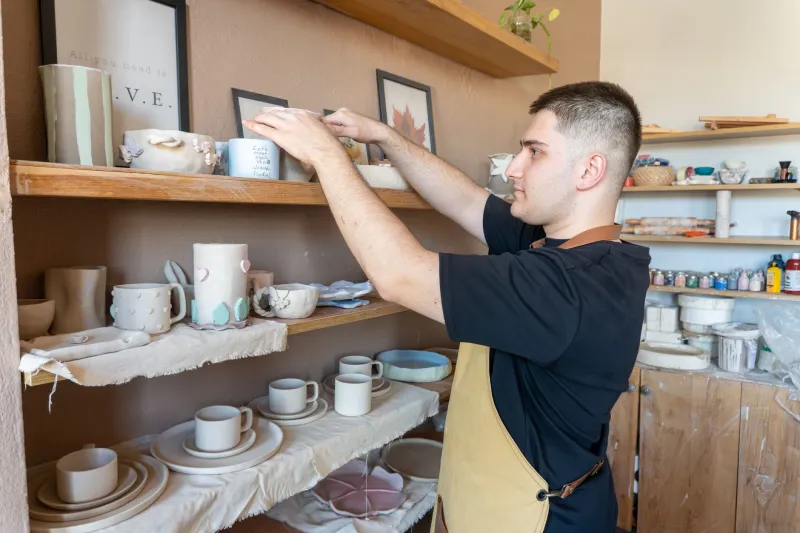
Photo: potter's hands glazing stoneware bowl in ceramic studio, via img.freepik.com
Every potter has a shelf. Not the good shelf, the other one — the shelf behind the wheel, or under the bench, or in the corner of the studio where the light isn't great. That's where the seconds live. The ones that came out of the kiln with a glaze that ran, a rim that leans, a thumbprint that didn't smooth out, a speck of kiln grit fused to the foot.
To a shop, that's a fault. To anyone who actually uses pottery, it's often the most interesting thing in the room. And right now, with studios across the UK doing regular clear-outs of that shelf, it's also the smartest way to buy handmade.
What 'seconds' actually means in a UK studio
In British pottery, the word covers a wide range. Some seconds are purely cosmetic: a glaze that pooled more heavily on one side, a slightly uneven lip, a bit of crawling where the glaze pulled back from the clay. Others are structural but minor: a foot ring that isn't quite flat, a handle set a few millimetres off-centre.
And some things that get labelled seconds aren't really flaws at all. Uneven rims are frequently a design choice — a potter throwing a soft, generous lip and then deciding it's not clean enough to sell at full price. Thumbprints in the base are the maker's signature, literally. Glaze runs are chemistry doing something the potter half-planned and half-didn't.
What seconds are not, or shouldn't be, is unsafe. A pot that hasn't been fired to temperature, a glaze that's crazed across the whole surface, a crack running through the body — those aren't bargains, they're bin jobs, and a decent studio will tell you so.
Why the flaws are the point
There's a reason people who collect seriously gravitate to seconds. A shelf of identical, faultless mugs tells you nothing about the person who made them. A shelf of pots with visible decisions in them tells you a lot.
You can see where a potter's thumb rested. You can see the moment they chose not to fight the kiln. You can see the one that came out a slightly different blue because it sat nearer the element. Those are the pots people pick up and turn over in their hands, and they're the ones that end up being used daily rather than saved for guests.
There's also an honesty to them. Handmade ceramics are sold as the product of a human being at a wheel, and seconds are the evidence.
The economics of nearly perfect
A studio second usually lands somewhere between a third and two-thirds of the full price, depending on how visible the fault is. That's the difference between admiring a maker's work from across a market stall and actually owning a piece of it.
For anyone building a collection on a normal budget, that's transformative. You can buy one flawless bowl, or three slightly wonky ones you'll use every day. Most of us, given a year, end up happier with the three.
It also supports the studio more directly than you might think. Seconds sales are how a lot of small UK potteries clear stock, recover material costs and keep the lights on between bigger collections. There's no distributor, no wholesaler, no middle layer — just you, a maker and a spreadsheet that balances slightly better at the end of the month.
How to shop a seconds sale responsibly
A few things worth knowing before you get carried away.
Follow the studios you like. Most small potteries announce seconds sales through their newsletter or social media first, often with a specific date and a limited window. Getting on those lists is the whole game.
Measure before you go. Take the internal dimensions of your cupboard, not the external ones. It's the single most common seconds-sale regret.
Bring your own wrapping. A box, some newspaper, a couple of tea towels. Studios can't always supply packaging, and a stoneware jug in a tote bag is a heartbreak waiting to happen.
Buy the pot, not the discount. If you wouldn't want it at full price, the reduction isn't a reason. That's how the shelf at home starts looking like somebody else's shelf.
Ask about the firings. Cone 10 reduction stoneware and a low-fire decorative piece are very different propositions for daily use.
Questions worth asking the maker
A good potter will happily talk you through the fault — and will tell you when something isn't fit for purpose. Ask:
- Is this cosmetic or structural?
- Is the glaze food safe and properly fitted, or is that crazing?
- Is it dishwasher or microwave safe, honestly?
- What caused it — the throwing, the glaze, or the kiln?
- Will the flaw get worse with use?
If the answer to any of those is a shrug, walk on. Seconds should come with a straight answer, not a mystery.
Studio second versus mass-market flaw
This is where a bit of judgement helps. A genuine studio second usually has one thing wrong with it, and the rest of the pot is beautifully made — a clean foot, an even wall, a handle that sits where your fingers want it.
A mass-market flaw tends to be systemic. Decals misaligned on every piece in a batch. Glaze cracked in a pattern across the whole surface. Sharp, unglazed rims. Chips that came from a shipping crate rather than a kiln. And a price label that was never honest to begin with.
The test is simple: does the flaw look like a decision, or like an accident of volume?
Living with a nearly perfect mug
Here's the quiet payoff. Within a fortnight you stop seeing the glaze run. Within a month, it's simply what that mug looks like, and you'd be annoyed if it were any other way. Meanwhile the flawless piece you paid full price for is still on the shelf, still being saved for a good enough occasion that never quite arrives.
The pot with the thumbprint in the base is the one that gets used.
That's the argument, really. Seconds aren't the compromised version of a potter's work. They're the version where you can see the work happening — and they're the version most of us can actually afford to live with. Keep an eye on your favourite studios' newsletters this winter. The shelf behind the wheel is always worth a look.