Throwing Lines and Honest Handles: Eight UK Potters on the Beauty of a Slightly Wonky Mug
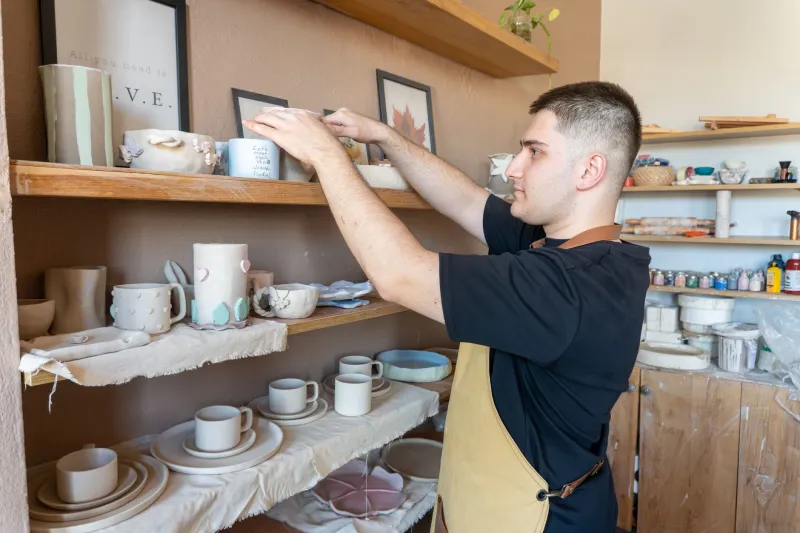
There is a mug on my shelf that refuses to sit straight. Its rim dips on one side, the glaze has pooled in a dimple near the handle, and the base rocks just enough to make a point. I reach for it most mornings. In 2026, when so much of the homeware aisle is smoothed into sameness, that small imperfection feels less like a flaw and more like a signature.
To find out why wonky mugs have such a hold on us, I asked eight UK potters about the marks they leave in clay — and the marks they hope buyers will treasure. Their answers were less about romance and more about rhythm: the speed of a wheel, the weight of a handle, the way a glaze breaks over a throwing line. Here is what they told me, plus a few practical notes for anyone building a morning shelf of handmade mugs.
Why the eye loves a wobble
Factory mugs are designed to be identical. Studio mugs are designed to be themselves. That difference shows up in tiny ways: a rim that rises and falls by a millimetre, a handle fixed a little lower than the last one, a glaze that thins over a ridge and pools in a hollow. None of these things make a mug harder to use. Often they make it easier to love.
'Perfect is a moving target,' says Maya Ellery, who makes soda-fired stoneware at The Kiln Room in Bristol. 'I want the mug to look like it was made by a person who was having a good day. A wonky rim is not carelessness; it is a record of pressure.'
That record is what draws so many of us to studio pottery. A handmade mug carries the memory of the hand that threw it, the kiln that fired it and the morning it was chosen. It is not trying to disappear into a matching set. It is asking to be picked up.
Eight makers on why the wobble matters
Maya Ellery, The Kiln Room, Bristol — Maya leaves throwing rings visible and lets soda glaze gather on the shoulder of each mug. 'If I smooth everything away, I lose the conversation between clay and fire,' she says. Her mugs are deliberately varied in weight, so a shelf feels like a gathering rather than a production line.
Tom Vickery, Cobble Lane Clay, Stoke-on-Trent — Tom grew up around the pottery industry and now works in a small studio nearby. 'The factory taught me consistency. The studio taught me character,' he says. He taps every handle before it is attached, listening for a hollow note that might mean a weak join.
Rhiannon Price, Cwm Studio, Powys — Rhiannon wood-fires in mid-Wales, where ash and flame decide the final surface. 'The kiln decides the last ten per cent,' she says. Her mugs often show speckles, toasting and a soft asymmetry that feels closer to weather than to design.
Euan Mackie, Saltire Ceramics, Fife — Euan makes speckled stoneware with handles that sit low and wide. 'If the handle feels like a handshake, you are halfway there,' he says. He tests each one with a full mug of water before it goes into the kiln, because balance matters more than symmetry.
Priya Shah, Gulabi Clay, Leicester — Priya works in warm, saturated colour and leaves brush marks visible. 'A wonky mug gives the eye somewhere to rest,' she says. 'It is not shouting at you. It is just being honest.' Her tip for buyers is simple: turn the mug over and look at the base. A tidy foot ring often signals a maker who cares about the parts you do not see.
Orla Finnegan, Lagan Handmade, Belfast — Orla throws in porcelain, a clay that remembers every touch. 'Porcelain is not forgiving, but it is expressive,' she says. Her cups often have a slight lean, which she describes as 'a small act of defiance against the ruler'.
Ben Hargreaves, Hargreaves & Ash, Hebden Bridge — Ben uses ash glazes that break over edges and gather in pools. 'The best mugs look a bit tired in the right way,' he says. 'Not worn out — just lived-in before they even reach you.'
Alice Trenowden, Trenowden Clay, Cornwall — Alice makes coastal-inspired mugs with soft, sea-worn profiles. 'I tell people to put the mug down and pick it up again,' she says. 'If the second pick-up feels better than the first, it is yours.'
How to judge a good handle
A handle is where a mug succeeds or fails. Hold it empty, then imagine it full. There should be room for your fingers without your knuckles scraping the body, and enough space for a thumb to rest on top. The handle should feel attached, not glued on: run a fingertip around the joins and look for sharp seams or hairline cracks.
Balance matters more than shape. A big handle on a small mug can feel clumsy; a delicate handle on a heavy mug can feel like a trap. If you can, fill it with water at the shop or studio and hold it for a few seconds. A good mug should feel steady at the wrist, not just pretty on the shelf. And do not ignore the rim: a thick, rounded rim can feel soft and generous, while a thin one can feel refined, but neither should be sharp against the mouth.
Caring for studio pottery without fuss
Always check the maker's instructions first, because glazes and clays vary. As a rule, hand washing is kindest: hot dishwasher cycles and harsh detergents can dull a glaze over time. Avoid thermal shock by letting a cold mug warm gradually before pouring in boiling water, and never move a hot mug straight to a cold surface.
Dry thoroughly, especially if the base is unglazed. Crazing — the fine web of lines in some glazes — is not automatically a fault, but it can stain over time. A paste of bicarbonate of soda and water can lift tea and coffee marks without scrubbing the surface. If a mug has a metallic lustre or gold trim, keep it out of the microwave and dishwasher.
Styling a shelf that looks lived-in
A mixed shelf works best when it looks like a rotation, not a display. Group mugs in odd numbers, vary heights and let one or two sit slightly forward. Repeat a colour or a clay body across the shelf so the eye has something to follow. Keep the mugs you actually use at the front, and put the more sculptural ones at the back.
Do not hide the imperfections. A pooled glaze or a visible throwing line is part of the object's story. Pair a wonky mug with a straight-sided jug, a chipped-enamel tin or a small glass vase, and the shelf becomes a conversation rather than a set. The point is not to make every piece match. The point is to make every piece earn its place.
The wonky mug is not a trend to be corrected. It is a reminder that the things we reach for every day can be useful, beautiful and a little bit human all at once. Mine still rocks on the shelf. I would not swap it for a straight one.