What Plays While the Clay Turns: Six British Potters on the Sound of the Studio
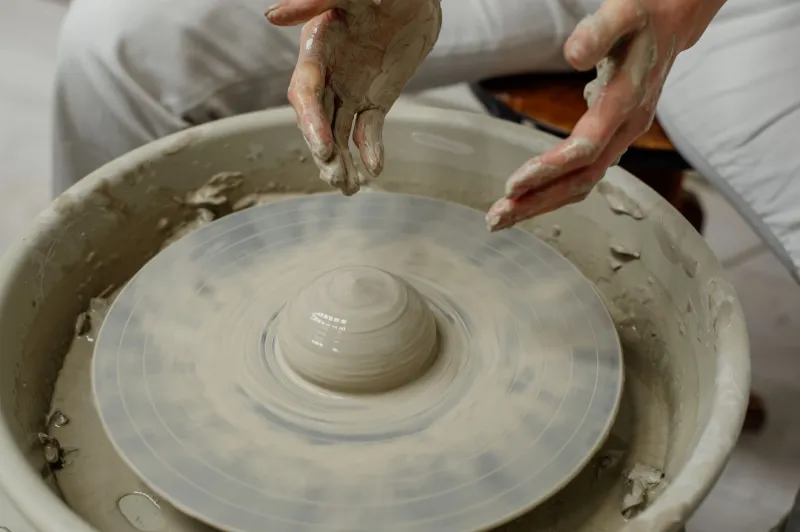
There is a particular sort of quiet in a pottery studio. It is not silence, exactly. It is the hum of a wheel, the wet slap of clay, the occasional creak of a stool. And then, in most studios, there is something else: a radio murmuring from a shelf, a record turning, a pair of headphones clamped over a clay-dusted ear.
We asked six British potters what they listen to while they throw. The answers were less about taste and more about rhythm — about how sound settles the mind, marks the time, and occasionally ruins a rim. No kiln charts here, promise. Just records, radios and the odd confession.
Ruth, Stoke-on-Trent: Radio 4 and the useful drone of voices
Ruth has been throwing in a shared studio near the Trent for a decade. Her soundtrack is almost always speech: the Today programme in the morning, Woman's Hour, the afternoon play, anything that fills the room without demanding a reaction.
'I can't have music with lyrics while I'm centring,' she says. 'I start listening to the words and the clay goes off-centre. It's like the song pulls my hands sideways.'
Radio 4 works because it is predictable. The cadence of a news bulletin, the rise and fall of an interviewer's question — it gives her a loose sense of time passing without competing for attention. She calls it 'company that knows when to shut up'. When the shipping forecast comes on, she stops for tea.
Callum, Glasgow: one side of vinyl, then a break
Callum throws in a converted garage in the southside of Glasgow. His rule is simple: one side of a record, then stand up, stretch, look out of the window at the bins.
'A side is about twenty minutes,' he says. 'That's a good stretch for me. Long enough to get into the rhythm of pulling, short enough that I don't wreck my back.'
He plays old folk and quieter jazz — Pentangle, Alice Coltrane, anything with space between the notes. The crackle matters to him. 'It's a bit like the clay,' he says. 'You get used to the imperfections. You stop trying to edit them out.'
He has tried playlists. They make him restless. 'A record has an end you can see coming. That helps.'
Priya, Bristol: headphones, playlists and the art of not hearing the door
Priya works from a small studio above a bike shop in Bristol. She shares the space with two others, so headphones are a courtesy as much as a preference. Her playlist is carefully built: ambient, dub, low-slung electronic music with no sudden changes.
'I need a wall of sound that doesn't surprise me,' she says. 'If a track drops, I drop the pot.'
She has a 'centring' list, a 'pulling' list and a 'tidying up' list, which is mostly Aretha Franklin. The tidying-up list is the only one with lyrics. 'By then the work is done. I can sing. Badly.'
Her one rule: no podcasts. 'I lose the thread, then I get annoyed, then I'm stood there with a half-pulled cylinder and no idea where I am.'
Meg, Leeds: silence first, then one album on repeat
Meg's studio is a spare room in a Victorian terrace. She starts every session in silence. Ten minutes, no radio, no music. Just the wheel and the window.
'It's a reset,' she says. 'I need to hear the clay before I cover it up with anything else.'
After that, she plays one album on repeat for the whole session. Recently it has been a lot of Nick Drake and a lot of Brian Eno. Repetition does something useful: the music stops being music and becomes a kind of weather. 'By the fourth time through, I'm not listening any more. I'm just moving. That's the goal.'
Tom, Cardigan: the radio as barometer
Tom throws in a shed on the edge of Cardigan, where the signal is patchy and the weather is a full-time character. His radio is tuned to BBC Radio 6 Music when it works and to static when it doesn't.
'You learn to work with the interference,' he says. 'A bit of crackle is fine. It's the ads I can't stand. I'll stop mid-pull to turn them off.'
He likes the unpredictability. A song he would never choose can come on and change the pace of the afternoon. 'I made a set of mugs last month to a funk show I'd never normally listen to. They came out looser. I'm not saying the music did it. But I'm not saying it didn't.'
Nadia, Norwich: drum and bass at seven in the morning
Nadia is the outlier. She throws to drum and bass, often before eight in the morning, in a studio on the edge of Norwich.
'People think it must be chaotic,' she says. 'It's the opposite. The tempo is so fast that my hands have to be calm. If I panic, it all goes wrong. The music burns off the nervous energy and leaves me steady.'
She puts on headphones so her studio mate can work in peace. 'I'm aware it's not for everyone. But centring a hundred mugs to a rolling breakbeat is one of the great quiet joys of my life.'
What the noise actually does
None of these potters agree on what to play. They do agree on why it matters. Sound sets a pace. It covers the awkward silence of concentration. It marks time, so you don't look at the clock every four minutes. It can also be a warning: if you're suddenly aware of the lyrics, you've stopped paying attention to the clay.
Maybe that's the gentle argument here. Music isn't just background. In a studio, it's a tool — as useful as a rib, a sponge or a good stool. It doesn't make the pot. But it changes the mood of the hands that make it.
A short, opinionated playlist
For wedging: something steady and unglamorous. Try a long mix, no vocals, nothing you'd put on at a party.
For centring: silence or drone. Eno's Ambient 1, or the shipping forecast if you're Ruth.
For pulling: one side of a record. Folk, jazz, anything with air in it. Callum would say Pentangle. Meg would say Nick Drake, four times over.
For tidying up: something with a chorus. Aretha. ABBA. Whatever gets the sponges rinsed.
And for the last pot of the day, when the light is going and your back has had enough: nothing at all. Just the wheel winding down. That's a soundtrack too.