Thumbprints in the Rib: Nine Potters on the Tools That Refuse to Retire
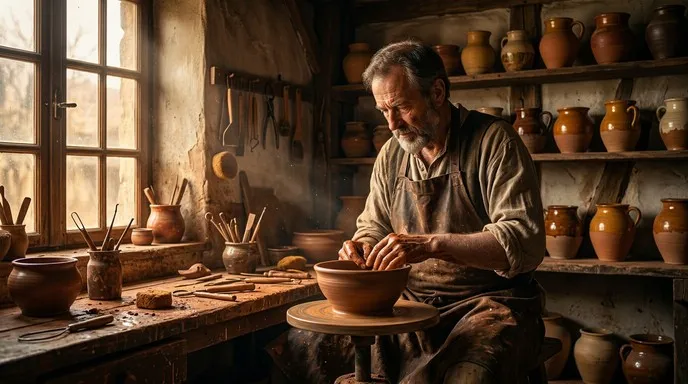
Photo: potter's worn wooden rib tool and clay-covered hands on studio bench, via images.stockcake.com
Every pottery studio has a drawer that would disappoint a showroom. No glossy hero pieces in there, just a tangle of wooden ribs, blunt needles, curling sandpaper and a sponge that has clearly lived a life. These are the things potters reach for without looking. The tools that have been dropped on concrete floors, left in buckets, borrowed by students and returned with a new stain. They are not glamorous. They are not the sort of thing you photograph for a shop page. But ask a maker what keeps the studio moving and you will hear about them again and again.
We spoke to nine potters around the UK about the worn-out objects they refuse to replace. Not a gear review, more a quiet inventory of habit, memory and the small rhythms that make a studio feel like a studio.
The Drawer of Fine Things
'Fine things' is how Mara in Bristol describes her tool drawer, with a fair amount of eye-rolling. She keeps it beside the wheel, and the handle is loose. Inside: a wooden rib with a thumb-shaped hollow worn into one side, a metal kidney with a softened edge, two needles stuck into a wine cork, and a small piece of chamois leather that has gone the colour of weak tea.
She bought the rib at a market in her first year of potting. 'It was cheap and it was the right shape,' she says. 'Now my thumb fits that hollow. A new one would feel like wearing someone else's shoes.'
That is the thing about worn tools. They stop being objects and become extensions of a particular pair of hands.
The Rib With a Memory
Mara's rib is not unusual. Almost every potter has one that has been sanded, soaked and handled into a new shape. The edges soften. The curve changes. What was once a crisp profile becomes something more forgiving.
'You learn to read it,' she says. 'A little dip here means it will not catch. A rough patch there means it needs a rub on the bat. You do not think about it. You just know.'
Replacement ribs are easy to buy. They arrive flat, neat and faintly clinical. Mara has three in a drawer. She uses the old one.
The Sponge That Outlasted Three Kilns
Iwan in Cardiff has a sponge that has seen three kilns come and go. It is greyish, slightly misshapen and has a corner missing. He keeps it in a jam jar beside his wheel and gets defensive if anyone tries to tidy it away.
'It is not about being mean,' he says. 'It is the right softness. A new sponge is too keen. It drinks too much water and takes the slip off in one go. This one has been broken in. It knows when to hold back.'
He has tried to retire it twice. Both times it came back out within a week. 'You cannot buy that with money. You buy it with time and a few hundred pots.'
The Bucket That Never Gets Clean
Priya in Leeds has a bucket that has not been truly clean since about her second month of potting. It is a plain plastic bucket, the kind you might use for mopping, but the inside is a landscape of dried slip and glaze residue. She calls it 'the history bucket'.
'It is not dirty in a bad way,' she says. 'It is a record. That grey band is the glaze I used all last winter. That pale patch is the slip from the big bowl run. I could scrub it, but why would I? It is part of the studio.'
She uses it for slaking down clay and for catching trimmings. It never goes near the kitchen. That feels important to mention.
The Wire With the Knot
Callum in Glasgow has a cutting wire with two wooden toggles and a knot in the middle. The knot has been there for years. He says it gives the wire a slight give, which he likes. A new wire feels rigid and overconfident.
'You develop a relationship with a wire,' he says. 'It is not romantic. It is just that you know how it will pull. If I change it, I will make different pots for a week and not in a good way.'
He has a spare wire in a cupboard. It has been there so long the packaging has gone soft.
The Needle in the Cork
Tess in Cornwall uses a potter's needle pushed into a wine cork. The needle is slightly bent. The cork has a thumbprint pressed into it. She uses it for scoring, for lifting rims, for checking the depth of a foot ring.
'It is the most useful thing I own and it cost nothing,' she says. 'I have proper tools. I have a nice needle tool with a wooden handle. But the cork one is the one I pick up. It fits my hand. It does not roll off the table.'
She has lost it twice. Both times she stopped working until it turned up.
The Paddle With a Shiny Edge
Ade in Stoke has a wooden paddle that has been used so often the edge is shiny and slightly rounded. He uses it for beating slabs and for adjusting rims. It was cut from an old breadboard by his grandfather.
'It is not a precious object,' he says. 'It is a piece of wood. But it has a weight I like. It has a sound. When you tap a rim with it, you can hear if the wall is even. A plastic rib does not give you that.'
The paddle lives on a nail above his bench. He says he would not know where to put a new one.
The Chamois That Holds the Shape
Nia in Sheffield keeps a chamois leather for smoothing rims and cleaning up seams. It is stiff in places, soft in others, and has a faint smell of clay and old soap. She has washed it many times. It never quite dries the same way.
'It has a memory of my hand,' she says. 'That sounds daft, but it does. It folds where I fold it. It has a little pocket where my thumb goes. A new chamois is floppy and anonymous. This one knows me.'
She uses it every day. It is the first thing she reaches for after opening the studio.
The Card That Became a Rib
Ruth in Norwich uses an old bank card as a flexible rib. The numbers have worn away. One corner is slightly ragged. She cuts it down years ago and has never replaced it.
'I like that it is thin,' she says. 'It gets into places a wooden rib cannot. And it is already the right size for my hand. I do not need a fancy tool. I need something that bends without breaking.'
She has a proper set of silicone ribs in a box. She says she uses them when she remembers. The card is the one that lives on the wheel head.
The Kidney With a Softened Edge
Ben in Manchester has a metal kidney that has lost its crispness. The edge is rounded. The surface is scuffed. He uses it for throwing off the hump and for shaping small bowls.
'It is not sharp anymore,' he says. 'That is the point. A new kidney can scrape. This one glides. It has been worn down by clay and water and my own impatience.'
He has tried a replacement. It felt too aggressive. He went back to the old one within a day.
What Replacement Really Means
None of these potters are sentimental about tools in a soppy way. They are practical. A worn tool works differently. It has been tuned by use. The edges have softened, the handles have shaped themselves, the surfaces have taken on a patina that is part clay, part skin, part time.
Buying new is easy. You can order a rib, a sponge, a wire, a needle and a bucket before lunch. But you cannot order the hollow that fits your thumb. You cannot order the softness of a sponge that has been rinsed ten thousand times. You cannot order the knot in the wire that makes everything feel just right.
That is why the old tools stay. They are not better in any measurable way. They are just more yours.
A Quiet Sort of Calm
There is a particular calm in reaching for a tool you do not have to think about. The studio is full of decisions — clay, glaze, temperature, timing. The worn rib is not one of them. It is simply there, waiting.
So the next time you see a potter's bench and wonder why they are using a sponge that looks ready for the bin, remember: it is not neglect. It is a relationship. The tool has been broken in by hand, and the hand has been broken in by the tool. That is a very handmade kind of calm.