Shelf Reserved: Eight Potters on the Pots That Never Go Up for Sale
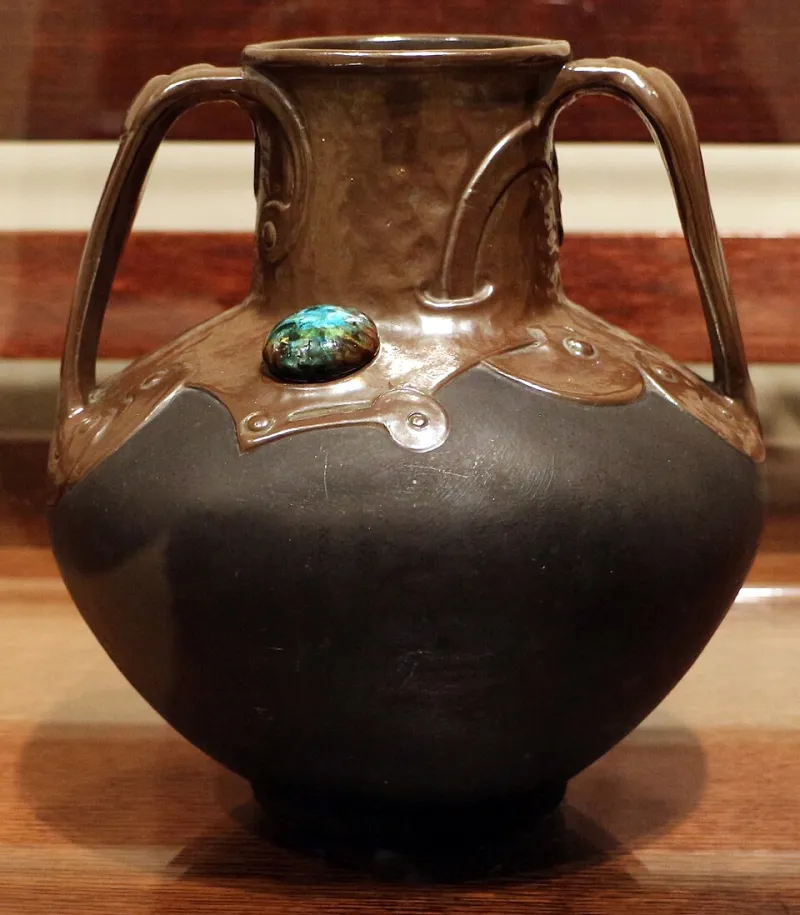
Photo: Sailko, CC BY 3.0, via Wikimedia Commons
There is a particular kind of shelf in a British pottery studio. It is rarely the tidiest. It may be a plank above the wheel, a windowsill behind the glaze buckets, or a corner of a battered IKEA unit that has survived three studio moves. Nothing on it has a price tag. Nothing is going in the window. And yet, if the studio caught fire, it is the shelf most potters would grab first.
In 2026, with open studios busy and online shops full of beautifully photographed mugs, it is easy to think of pottery as a series of finished objects moving from bench to box to doorstep. But spend an afternoon with a potter and you notice the other current: the work that stays. The first attempt. The near-miss. The piece that carries a person, a season or a lesson inside it.
We asked eight UK potters to talk about one pot they have kept rather than sold. The answers were funny, frank and occasionally a bit wobbly — much like the pots themselves.
The First Bowl That Wouldn’t Stand Up
Mara Ellery, who works from a shared studio in Stoke-on-Trent, points to a small stoneware bowl with a base so uneven it rocks gently when you touch it. She made it in 2019, during her first term of evening classes.
‘It was supposed to be a cereal bowl,’ she says. ‘It is now a bowl for keys, because cereal would leave the building.’ The glaze is patchy, the rim is thick on one side and the whole thing leans like it has had a long day. She keeps it next to her wheel.
‘When I’m teaching beginners, I bring it out. People relax when they see it. It says: this is where everyone starts. It is not a failure. It is just early.’
The Glaze That Went Rogue
Rowan Pike, a Bristol-based potter, keeps a tall vase glazed in what he calls ‘a beautiful accident’. He had been testing a new iron-rich glaze and expected a soft honey colour. The kiln gave him something closer to stormy petrol blue, with a crackle that looks like river ice.
‘I have tried to repeat it four times,’ he says. ‘The kiln has refused. So the vase stays here. It is a reminder that I am not fully in charge.’
The vase has a small lean and a pinprick bubble on one side. Pike says he would never sell it because he cannot promise the same result again. ‘It is not a product,’ he says. ‘It is a conversation I had with the kiln, and the kiln got the last word.’
The Mentor’s Jug
In Cardigan, Tamsin Vale keeps a small earthenware jug on the windowsill of her studio. It was made by her late mentor, an older potter who taught her to pull handles without panic. The jug is not precious in a museum sense: the handle is slightly off-centre, the glaze has a chip near the foot, and there is a faint thumbprint near the spout.
‘I use it for milk most mornings,’ Vale says. ‘That feels more respectful than wrapping it in tissue. It was made to be used. It was also made by someone who believed I could do this work, which is a different kind of glaze entirely.’
She says the jug reminds her that pottery is a chain of hands. ‘You are never really making alone. Even when you are in a shed at seven in the morning, someone taught you something.’
The Kiln Accident with a Good Attitude
Iwan Rees, who pots in Powys, kept a wide platter that came out of a firing with a dramatic crack across one side. He had planned to sell it as a serving dish. Instead, it became a studio talisman.
‘The crack is not hidden,’ he says. ‘It is right there, doing its thing. But the platter still rings when you tap it. It still holds a cup of tea and a slice of cake. That feels useful to me.’
Rees uses the platter for glaze tests and small tools. He says the piece taught him the difference between a flaw and a failure. ‘A flaw is information. A failure is just a story you tell yourself when you are tired.’
The Mug with the Wrong Handle
Bea Hollis, a Leeds potter, has a mug with a handle that sits far too low. She made it during a difficult winter a few years ago, when she was juggling studio work with caring responsibilities. The mug is heavy, the glaze is a washed-out green, and the handle looks like it has given up halfway through its journey.
‘It is genuinely awkward to drink from,’ she admits. ‘But it is the mug I reach for when I need to be gentle with myself. It is not efficient. It is not Instagram-ready. It is just mine.’
Hollis says she keeps it because it marks a period when her work had to fit around life, rather than life fitting around work. ‘Pots hold time. That one holds a very specific kind of tired.’
The Piece That Holds a Person
Nia Okonjo, who works in Glasgow, keeps a small lidded jar made by her grandmother in Nigeria. It is not a studio piece in the technical sense, but it lives among Okonjo’s test tiles and brushes.
‘It came to me with a box of recipes and a broken watch,’ she says. ‘The lid does not quite seal. But it is the most important object in my studio.’
Okonjo makes functional domestic ware, mostly mugs and bowls, and says the jar keeps her connected to a longer idea of making. ‘Not everything has to be resolved or improved. Some things are kept because they are witnesses. That jar has seen more family dinners than I have.’
The Test Tile That Became a Talisman
Colm Byrne, a Belfast potter, kept a plain test tile from his first year of serious glaze testing. It is a small square of clay with a smear of green-brown glaze across one half. On the back, in pencil, he wrote a date and the word ‘nearly’.
‘I have hundreds of test tiles now,’ he says. ‘This one stays on the shelf because it is the first time I understood that glazing is not magic. It is observation. You look, you note, you try again.’
Byrne says he has been tempted to throw it out during studio clear-outs. ‘But then I think: no. That little square is the reason I know anything. It is the beginning of the whole conversation.’
The Bowl That Refused to Be a Product
Elspeth Gow in Dundee keeps a deep serving bowl with a glaze that crawled badly on the inside. It looks, she says, ‘like a map of somewhere that does not exist’. She made it for a market in 2022 and then decided not to take it.
‘It was not saleable in the way people expect. But I liked it too much to smash it. So it became the studio salad bowl, and then the studio everything bowl.’
Gow says the bowl is a useful antidote to the pressure to make every piece consistent. ‘A studio needs one or two objects that are allowed to be odd. Otherwise you start believing your own product photos.’
What the Shelf Says
None of these potters described their kept pots as masterpieces. That seems to be the point. The shelf reserved for the unsold, the un-sellable and the never-quite-finished is less a display of skill than a record of relationship: with clay, with a teacher, with a season of life, with the kiln’s stubborn personality.
In a year when handmade ceramics are more visible than ever, the kept pot is a quiet reminder that not everything in a studio is meant to travel. Some pieces stay put. They hold the door open for the next attempt.
If you visit an open studio this winter, look past the price tags for a moment. There may be a wobbly bowl on a high shelf, a jug with a chipped foot, a platter with a crack that still rings. Ask about it if the potter seems willing. You will probably get a better story than any product description can offer.