Wrapped Like It Matters: Getting a Handmade Pot Through the Post Unshattered
There is a particular sound a handmade bowl makes when it dies. It is not a crash. It is a short, dry tick, muffled by cardboard, and it happens somewhere between a van in Warrington and a doorstep in Bristol. I have heard it once, opening a parcel on my own kitchen table, and I have been slightly annoying about packing tape ever since.
If you are posting ceramics this gifting season — or receiving them, or standing in a Post Office queue behind someone posting them — this is for you. Not a lecture. More a set of habits, borrowed from people who do it every week and have the emotional scars to prove it.
The order of operations nobody teaches you
Most bad parcels are not badly wrapped. They are badly sequenced. Potters tend to work inside-out, and the good ones are almost superstitious about it.
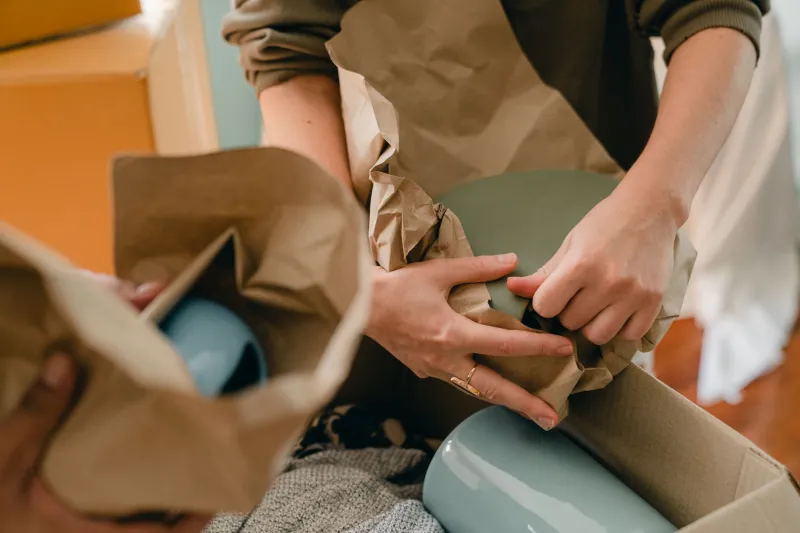
- Wrap the piece itself first. Tissue against the glaze, then a soft layer, then bubble wrap with the bubbles facing inwards on glazed surfaces. Bubbles pressed against a glossy rim for a week can leave a ghost of themselves behind.
- Bind it. Tape the bubble wrap to itself so the pot cannot shift inside its own cocoon. A pot rattling around in looser wrapping is a pot being sanded by its own packaging.
- Float it. The wrapped piece should sit in a bed of loose fill — scrunched paper, cornstarch peanuts, air pillows — with a good 5cm of clearance on every side. It should not touch the walls of the box.
- Box, then box again. The inner box goes into a larger outer box with more fill between the two. This is the single most reliable thing you can do, and the single thing most people skip.
- Tape every seam, not just the middle. Two strips across the top, two along the base, corners reinforced. Boxes fail at corners.
Hannah, who runs a small studio pottery in Sheffield, puts it bluntly: "The box is not packaging. The box is the outside of the cushion. If the box can deform, the pot is taking the hit."
What the word 'fragile' actually does
Here is the disappointing truth, repeated to me by three separate potters: a 'FRAGILE' sticker is not a handling instruction. It is a label that helps a sorting office know what to do if something goes wrong, and it is read, at speed, by people handling several hundred parcels an hour.
It is not nothing. It is also not a force field.
What actually protects your parcel is boring: mass, clearance, and rigidity. A heavy pot needs more clearance than you think, because heavy things keep moving after the van stops. A tall vase needs its own internal support, or a rolled tube of card inside the neck to stop it folding. A set of four mugs should never be posted as a cluster — wrap each one individually and pack them so no two are touching, ideally with a card divider between them.
"I used to write 'PLEASE HANDLE WITH CARE' in marker across every side," says Dev, a studio potter in Leeds who ships roughly forty parcels a week in December. "Now I write nothing and spend the time on a better inner box. My breakage rate dropped by about three-quarters. The tape did more than the marker ever did."
Insurance, and the awkward question of value
Postal insurance will usually cover the price you can prove. It will not cover the fact that the mug was the last one your gran threw before she stopped potting, or that the bowl was the piece you bought on the day you decided to leave your job.
Practical steps potters recommend:
- Photograph the piece before packing, ideally against a plain background, with a scale reference. Most couriers want evidence of condition, not just value.
- Keep the receipt or listing screenshot. For a commission, a short written confirmation of the agreed price is enough.
- Declare the real value. Under-declaring to save a few pounds is the most common self-inflicted wound in this whole business.
- Choose a service with tracking and a signature, and check the compensation ceiling — some of the cheaper options cap out well below the price of a decent teapot.
- Photograph the packed parcel, sealed and labelled, before it leaves your hands. It takes ten seconds and settles arguments later.
The worst parcel tales (a small, grim anthology)
Everyone who posts pots has one. Hannah's was a stoneware jug sent to a customer in Cornwall that arrived in what she describes as "a bag of gravel, with a note from the depot saying it had been 'repackaged'." Dev once had a box returned to him, unopened and undamaged, three weeks after he had already replaced the piece as lost — the tracking had simply stopped updating somewhere near Peterborough and then, quietly, resumed.
And then there is the reverse: the parcel that arrives beautifully, thickly packed, with a handwritten note, and you feel a small rush of affection for a stranger you will never meet. That is the other reason to pack well. The opening is part of the gift.
When to stop posting altogether
Some things should not go in a van. If a piece is irreplaceable, unusually thin-walled, or carries weight beyond its price, the kindest thing is often to arrange a handover. Meet in a café. Post it in a rigid tube inside another rigid tube if you must. Or wait.
Which brings up the quiet, sensible option that potters quietly love: the January studio visit. Many UK studios run open days or welcome collections in the new year, once the December rush has drained away. If you are buying for someone local, ask whether you can collect in person — most makers will say yes, and will be visibly relieved.
And if you are the one receiving a handmade parcel this month, do the sender a small favour: open it on a soft surface, keep the box, and send a photo of the pot in its new home. That message travels back through email faster than any courier, and it arrives intact every time.